Electromagnetic Induction
Overview
Electromagnetic induction is the production of an induced emf, and an induced current if the circuit is complete, when the magnetic flux linkage changes through a conductor or coil.
This topic is a major link between magnetism and electricity, and underpins electric power generation, transformers, microphones, pickups, braking systems, and many sensing devices.
A key exam idea:
Induction does not occur simply because a magnetic field is present. Induction requires changing magnetic flux linkage.
Core Ideas
Electromagnetic-induction questions revolve around a few linked ideas:
- magnetic flux measures how much field passes through a surface
- magnetic flux linkage includes the number of turns in a coil
- induced emf depends on the rate of change of flux linkage
- Lenz’s law determines direction by opposing the change
- induction can be produced by changing field strength, area, orientation, or relative motion
- eddy currents are a bulk-conductor consequence of changing flux
Exam Relevance
Students are expected to:
- use the correct angle in
- distinguish flux from flux linkage
- apply Faraday’s law in sign and magnitude form
- use Lenz’s law systematically for current direction
- interpret flux-time and emf-time graphs
- recognise when induction does or does not occur
Prior Links Between Electricity and Magnetism
Earlier topics established that:
- electric currents produce magnetic fields
- magnetic fields exert forces on moving charges and currents
See:
Electromagnetic induction completes the connection:
- changing magnetic conditions can produce emf and current
Key Representations
Magnetic Flux
Definition
Magnetic flux measures how much magnetic field passes through a surface.
For a uniform field:
where:
- = magnetic flux density
- = area of surface
- = angle between the magnetic field and the area normal
Angle Convention
This is one of the most common mistakes.
- is measured between the field direction and a line perpendicular to the surface
- if the angle to the plane is given, convert first
Maximum and Zero Flux
- maximum flux when field is perpendicular to the surface:
- zero flux when field is parallel to the surface:
Unit
Visual Reference
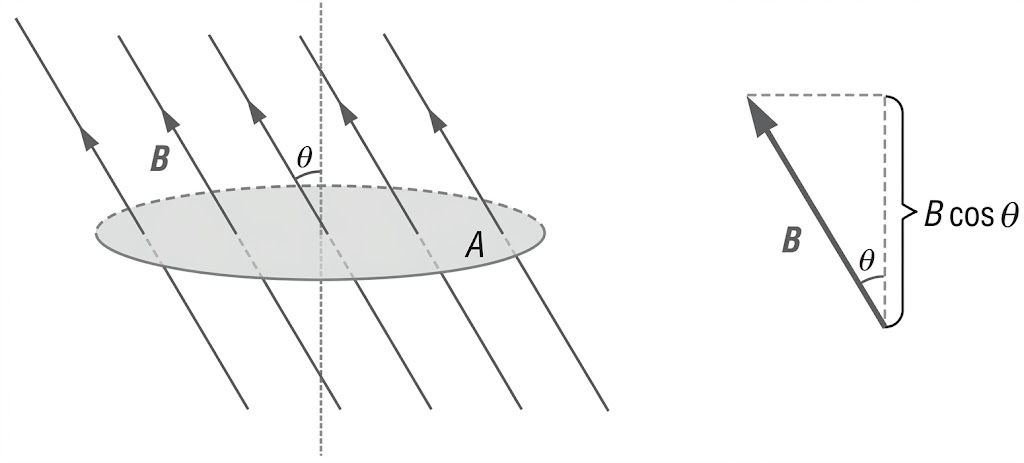
Figure: Magnetic flux through a surface depends on the perpendicular component of the magnetic field. The angle is taken relative to the surface normal, not the plane itself.
Magnetic Flux Linkage
For a coil with turns:
This is magnetic flux linkage.
Factors Affecting Flux Linkage
So flux linkage changes if any of the following changes:
- number of turns
- magnetic field strength
- area
- orientation
Faraday’s Law
The induced emf equals the negative rate of change of magnetic flux linkage:
Average form:
Meaning
Larger induced emf occurs when:
- flux linkage changes more rapidly
- a stronger field is used
- more turns are used
- a larger area is used
- faster rotation or motion occurs
Lenz’s Law
The induced current flows in a direction such that its magnetic effects oppose the change causing it.
This explains the negative sign in Faraday’s law.
Do not memorise the minus sign mechanically.
Why It Must Oppose Change
If the induced current assisted the change, energy would be created without input. This would violate conservation of energy.
Direction of Induced Current
General method:
- Decide whether magnetic flux linkage is increasing or decreasing.
- The induced field must oppose that change.
- Determine the induced field direction.
- Use the right-hand grip rule to determine current direction.
Ways to Produce Induction
Any method that changes flux linkage can induce emf.
1. Move Magnet or Coil
- magnet towards coil
- magnet away from coil
- coil entering or leaving field
2. Rotate Coil
Changes angle continuously.
3. Change Coil Area
Flexible loop expanding or shrinking.
4. Change Magnetic Field Strength
Increase or decrease electromagnet current.
5. Nearby Changing Current
Changing current in one coil changes the field through another coil.
Experimental Observations
Faster Motion Gives Larger emf
Move a magnet faster towards a coil:
- larger rate of change of flux
- larger galvanometer deflection
Reverse Motion Reverses Current
Moving a magnet away instead of towards the coil reverses induced current direction.
Switching Nearby Coil On or Off
When current in a nearby coil changes:
- magnetic field changes
- induced emf appears in the second coil
A steady current gives no induction after the field becomes constant.
Motional emf Overview
If a conductor of length moves through a magnetic field at speed :
This is due to magnetic force on charges causing charge separation.
See Motional emf.
Alternating Current Generators Overview
A rotating coil in a magnetic field experiences continuously changing flux linkage, producing alternating emf.
Key features:
- sinusoidal output
- mechanical energy converted to electrical energy
- depends on rotation speed, , , and
See Alternating Current Generators.
Eddy Currents
When bulk conductors experience changing flux, circular currents are induced inside the material.
Effects
Heating Loss
Energy is dissipated as thermal energy.
Magnetic Braking
Opposing forces slow motion.
Damping
Used in moving-coil instruments.
Reduction
Use laminated cores or slotted metal sheets to reduce current loops.
Transformers Preview
Transformers use electromagnetic induction to change AC voltage levels.
- a primary coil is supplied with AC
- changing magnetic flux occurs in the iron core
- emf is induced in the secondary coil
See:
Graph Skills
Flux-Time Graph
From Faraday’s law:
So:
- the gradient of a flux-linkage-time graph gives emf
- a steeper slope means larger emf
- zero slope means zero emf
Sinusoidal Relations
For rotating coils:
- flux linkage varies sinusoidally
- induced emf also varies sinusoidally
- emf is phase-shifted relative to flux linkage
Worked Examples
Example 1: Coil Rotated by
A coil initially has maximum flux linkage . It is rotated so the final flux linkage is zero in time .
Example 2: Magnet Held Still Near Coil
A magnet is stationary near a coil.
Change in flux linkage:
Therefore:
Example 3: Field Doubled in the Same Time Interval
Doubling the change in doubles the change in flux linkage, so the induced emf doubles.
Formula Sheet
Magnetic Flux
Flux Linkage
Faraday’s Law
Average Form
Motional emf
Common Pitfalls
- using angle to plane instead of angle to normal
- thinking presence of field causes induction
- forgetting flux linkage includes
- thinking maximum flux means maximum emf
- ignoring the sign meaning in Faraday’s law
See Electromagnetic Induction Common Exam Traps.