Magnetic Fields
Overview
Magnetic fields describe how magnets and electric currents influence the space around them. They are fundamental to motors, generators, transformers, loudspeakers, magnetic storage devices, and many modern technologies.
For H2 Physics, this chapter focuses on:
- what a magnetic field is
- how magnetic fields are represented
- magnetic flux density
- magnetic fields produced by electric currents
- simple field calculations
- comparing field patterns
This topic is closely linked to:
Core Ideas
Magnetic-fields questions revolve around a few main ideas:
- moving charges and electric currents produce magnetic fields
- magnetic fields are represented by field lines and magnetic flux density
- current geometry determines field pattern
- the right-hand grip rule sets field direction from conventional current
- magnetic fields from multiple sources combine by vector addition
- solenoids and electromagnets are practical ways to create stronger, more controlled fields
Exam Relevance
Students are expected to:
- interpret field diagrams and direction conventions correctly
- distinguish straight-wire, coil, and solenoid field patterns
- apply the right-hand grip rule using conventional current
- use standard proportional reasoning or simple formulas for current-produced fields
- explain why solenoids and electromagnets behave the way they do
Core Physical Idea
A moving electric charge produces a magnetic field.
This means electric current, which is moving charge, can create magnetic effects. Different conductor shapes create different magnetic field patterns.
Magnetic fields can also exert forces on moving charges and currents, studied later in Magnetic Force.
Key Representations
What Is a Magnetic Field?
A magnetic field is a region where:
- a magnetic material may experience a force
- a moving charged particle may experience a force
- a current-carrying conductor may experience a force
The field is represented by magnetic flux density:
Its magnitude is:
SI unit:
Magnetic Field Lines
Magnetic field lines are diagrams used to represent magnetic fields.
Rules
- outside a magnet, field lines go from North pole to South pole
- field lines form continuous loops
- the tangent to a field line gives field direction
- field lines never cross
- closer spacing means stronger field
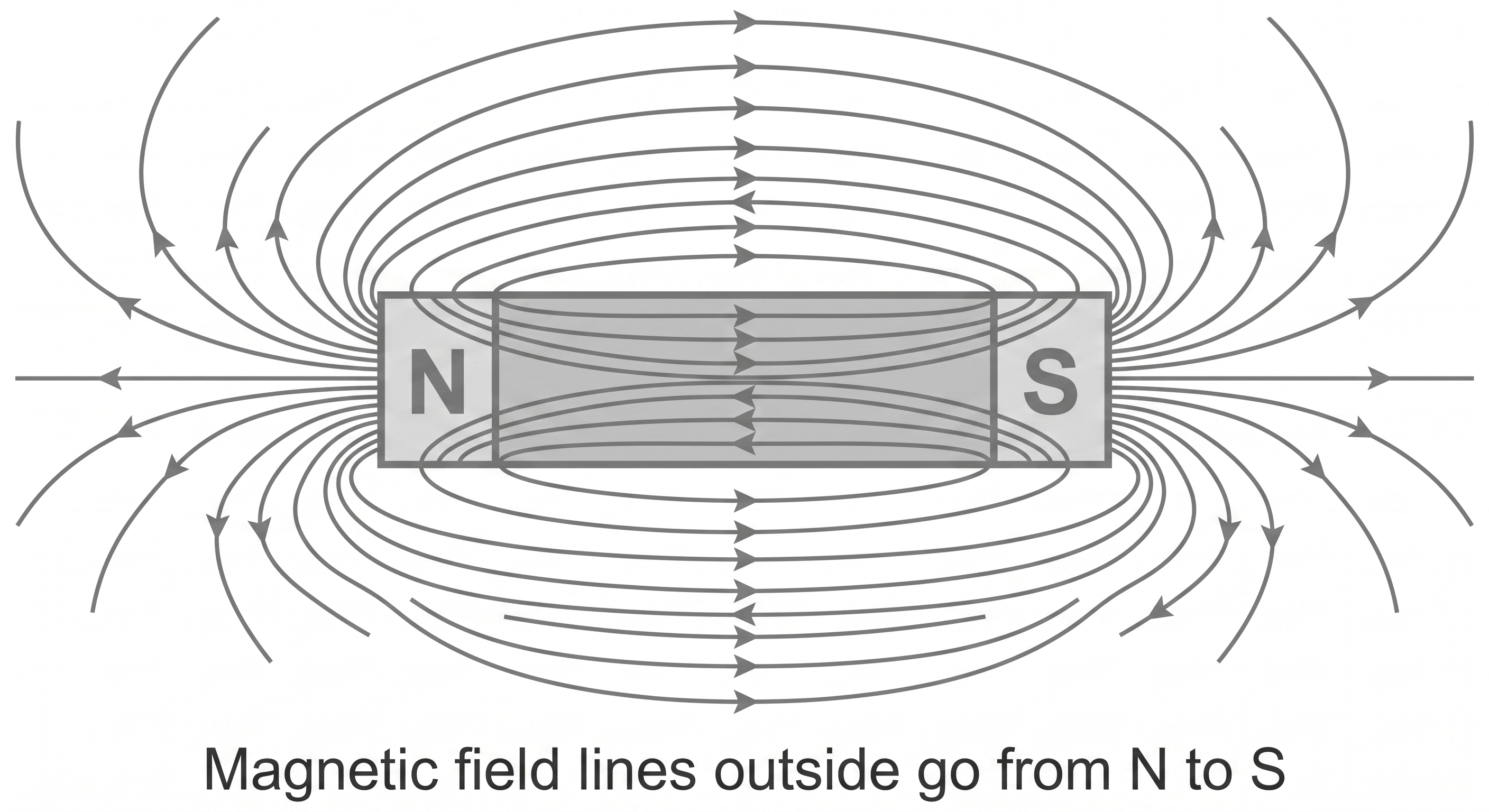
Figure: Magnetic field lines around a bar magnet. Outside the magnet, field lines go from North to South.
Symbols in 2D Diagrams
- : field into page
- : field out of page
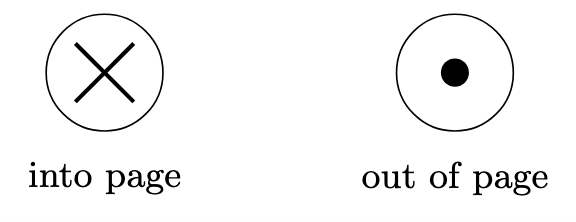
Figure: Dot-and-cross notation for magnetic field direction in 2D diagrams.
Uniform vs Non-Uniform Fields
Uniform Magnetic Field
A uniform field has:
- parallel lines
- equal spacing
- constant direction
- constant magnitude
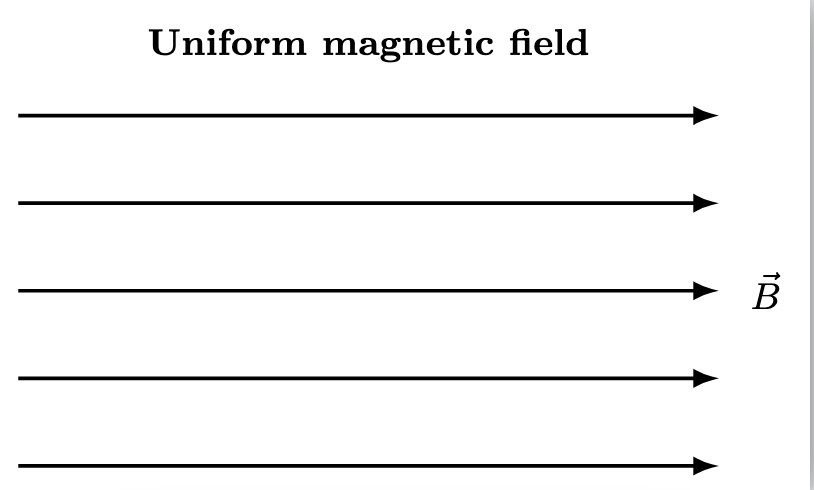
Figure: Uniform magnetic field represented by parallel, equally spaced field lines.
Example:
- central region inside a long solenoid
Non-Uniform Magnetic Field
A non-uniform field has changing spacing and/or changing direction.
Example:
- field near a bar magnet
- field near a straight wire
Magnetic Flux Density
Magnetic flux density measures magnetic field strength.
Larger means stronger magnetic effects.
It is a vector quantity, so direction matters.
Where only size is needed, use scalar .
Fields Produced by Currents Overview
Electric current produces magnetic fields.
Detailed treatment: Magnetic Fields from Currents
Long Straight Wire
Field lines are concentric circles around the wire.
Magnitude:
where:
- = current
- = perpendicular distance from wire
- = permeability of free space
Field strength decreases as distance increases.
Circular Coil
A current-carrying circular coil produces a concentrated field near its centre.
At the centre:
where:
- = number of turns
- = radius
Solenoid
A solenoid is a long coil of wire.
Inside the central region:
- field is strong
- field is approximately uniform
For a long solenoid:
where:
- = turns per unit length
More details: Solenoids and Electromagnets
Right-Hand Grip Rule Overview
Used to determine field direction around a current.
Straight Wire
- thumb points in direction of current
- curled fingers show magnetic field direction
Solenoid or Coil
- fingers follow current around the turns
- thumb points to the solenoid North pole and internal field direction
Detailed page: Magnetic Fields from Currents
Electromagnet Overview
A solenoid with a soft iron core forms an electromagnet.
Advantages:
- can be switched on or off
- strength can be varied
- polarity can be reversed by reversing current
Detailed page: Solenoids and Electromagnets
Earth’s Magnetic Field
Earth behaves approximately like a large magnet.
Useful effects:
- a compass aligns with Earth’s field
- it helps navigation
Typical field strength:
Earth’s field is weak compared with laboratory electromagnets.
Superposition of Magnetic Fields
If several sources create magnetic fields at the same point, the resultant field is the vector sum.
Use ideas from Vectors.
Examples:
- two nearby wires
- coil plus external magnet
- multiple conductors
Comparing Field Patterns
Straight Wire
- circular field lines
- strongest near wire
Circular Coil
- stronger concentrated central region
- resembles short bar magnet
Long Solenoid
- nearly uniform field inside
- weak field outside
Bar Magnet
- non-uniform external field from North to South
Short Worked Examples
Example 1: Straight Wire Trend
A point is moved further from a wire carrying constant current.
Since:
as increases, decreases.
Example 2: Stronger Solenoid
Two identical solenoids, but one carries double current.
Since:
doubling doubles .
Example 3: Coil with More Turns
If increases, the field at the centre increases proportionally.
Common Exam Traps Overview
Detailed page: Magnetic Fields Common Exam Traps
Frequent mistakes:
- using the wrong right-hand grip direction
- drawing crossing field lines
- confusing field with force
- assuming outside a solenoid field is exactly zero
- forgetting magnetic fields add vectorially
- misidentifying the North pole of a solenoid
Summary Sheet
Definitions
- magnetic field: region where magnetic effects act
- magnetic flux density:
Key Formulae
Straight Wire
Circular Coil Centre
Long Solenoid
Direction Rules
- straight wire: right-hand grip rule
- solenoid: thumb gives North pole
Field Strength Factors
Increase by:
- larger current
- more turns
- smaller coil radius at coil centre
- soft iron core for an electromagnet