Electric Fields
Overview
Electric Fields describes how charges exert forces on other charges through space without direct contact. This topic connects ideas from Forces, Vectors, Energy Forms and Conservation, and later links to Current Electricity Fundamentals.
A charge creates an electric field around itself. Another charge placed in that field experiences an electric force.
Core Ideas
Electric-fields questions revolve around a small number of linked ideas:
- charges exert electric forces on one another
- electric field strength is force per unit positive charge
- electric fields add vectorially, but electric potential adds algebraically
- electric potential and electric potential energy give an energy viewpoint
- uniform fields lead to constant force and constant acceleration
- graph shapes for , , and are different and must not be mixed up
Exam Relevance
This topic is heavily tested through:
- direct substitution into Coulomb’s-law, field, potential, or energy formulas
- comparison of vector and scalar addition
- graph interpretation of , , and against distance
- charged-particle motion in uniform electric fields
- explanation questions involving direction, sign, and field-line reasoning
Core Physical Idea
- Positive and negative charges interact through electric force.
- Like charges repel.
- Unlike charges attract.
- The interaction weakens with distance.
- Fields allow us to describe force at every point in space.
Key Representations
Coulomb’s Law
For two point charges and separated by distance :
where:
- = permittivity of free space
- = separation between charges
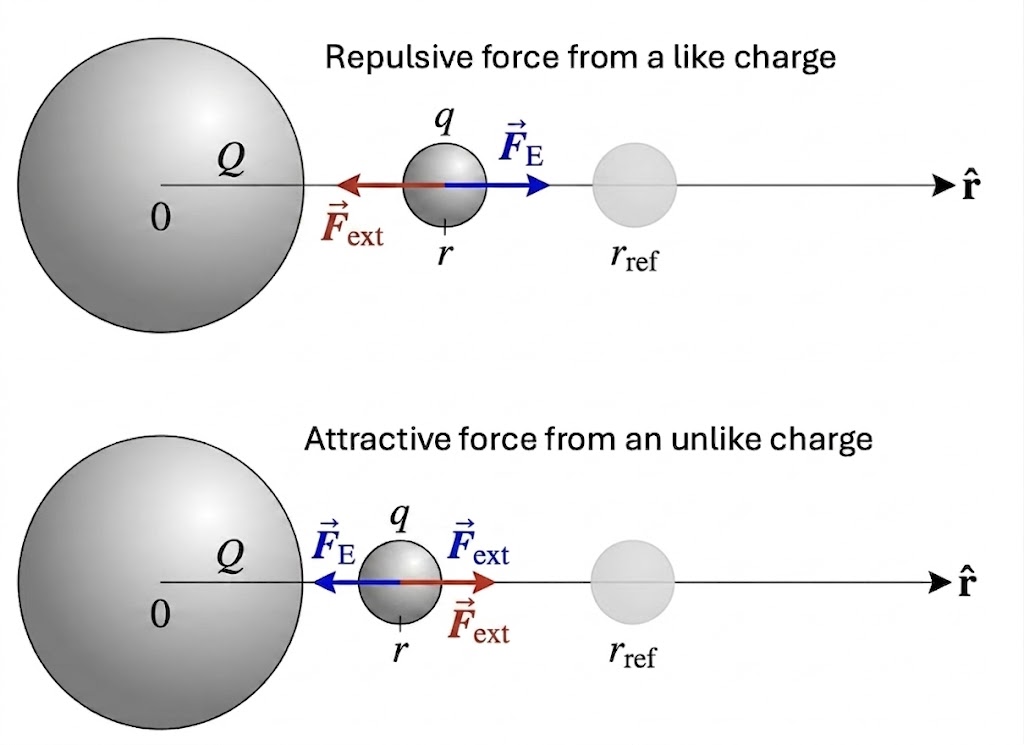
Figure: Electric force on a test charge due to a source charge. The force acts along the line joining the charges, and the charge signs determine whether the interaction is attractive or repulsive.
Key Ideas
- Force acts along the line joining the charges.
- Magnitude follows inverse-square dependence:
- Use charge signs to determine attraction or repulsion.
Electric Field Strength
Electric field strength at a point is the force per unit positive charge placed at that point.
Units:
- N C
- V m
Electric field strength is a vector quantity.
Direction of
Defined as the direction of force on a positive test charge:
- away from positive source charges
- towards negative source charges
Electric Field Due to a Point Charge
For source charge :
Trends with Distance
- stronger when closer to the charge
- falls rapidly as increases
- radially outward for
- radially inward for
Superposition of Fields
If several charges are present:
- total electric field is the vector sum of all individual fields
This requires careful attention to direction.
Potential, however, is added as a scalar quantity. See Electric Potential and Energy.
Electric Field Lines
Field lines are visual representations of electric fields.
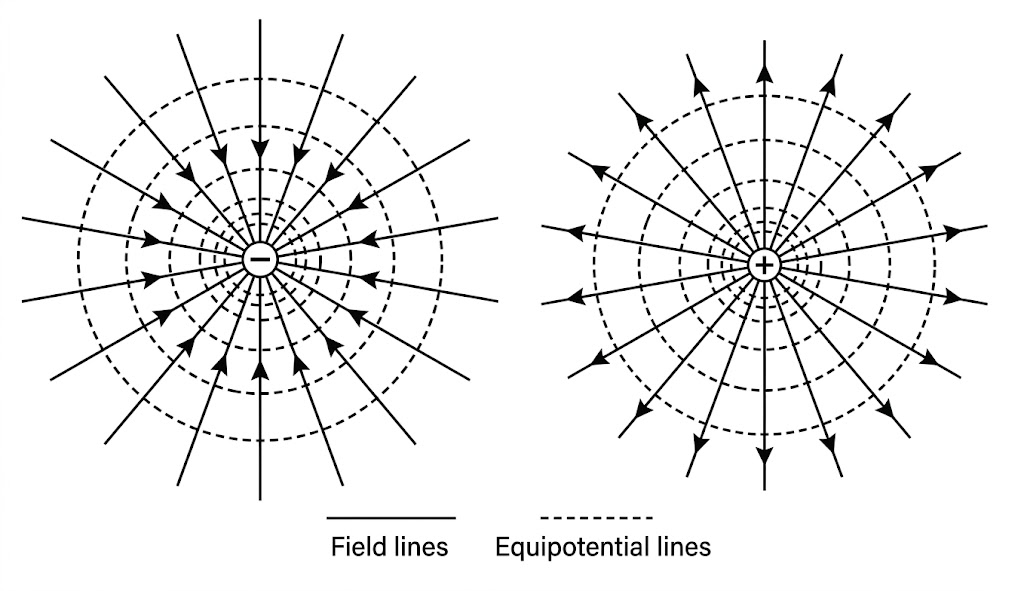
Figure: Field lines show direction and relative strength. The closer the lines, the stronger the field. Equipotential lines or surfaces are perpendicular to the field direction.
Rules
- start on positive charges
- end on negative charges
- arrows show field direction
- never cross
- closer spacing means stronger field
Common Patterns
Isolated Positive Charge
Radially outward.
Isolated Negative Charge
Radially inward.
Opposite Charges
Lines go from positive to negative.
Like Charges
Lines bend away from the central region.
Uniform Electric Field
Between large parallel oppositely charged plates, the field is approximately uniform in the central region.
Characteristics:
- constant magnitude
- constant direction
- parallel equally spaced field lines
For plate separation and potential difference :
This is important for charged-particle motion.
Electric Potential Overview
Electric potential at a point is work done per unit positive charge by an external agent bringing a small test charge from infinity to that point.
Unit:
- volt (V)
- J C
Electric potential is a scalar quantity.
For a point charge:
See Electric Potential and Energy.
Electric Potential Energy Overview
Potential energy of charge at a point:
For point-charge interaction:
Interpretation:
- like charges close together give positive potential energy
- unlike charges close together give negative potential energy
Equipotential Idea
An equipotential line or surface joins points with the same electric potential.
Properties
- No work is done moving a charge along an equipotential.
- Equipotential lines are perpendicular to electric field lines.
- Closer spacing of equipotential lines indicates stronger field.
Field-Potential Gradient Relation
Electric field strength is related to potential gradient:
Meaning:
- the field points in the direction of decreasing potential
- a larger gradient means a stronger field
For a uniform field:
Charged Particles in Fields Overview
See Charged Particles in Fields.
Force on a charge in an electric field:
Important Consequences
- a positive charge accelerates in the direction of the field
- a negative charge accelerates opposite to the field
Magnitude of acceleration:
Motion in Uniform Fields
Initially at Rest
The particle accelerates uniformly.
Velocity Parallel to the Field
Speed changes in straight-line motion.
Velocity Perpendicular to the Field
- horizontal motion remains constant
- vertical motion is accelerated
Hence the path is parabolic.
This links strongly to Kinematics.
Graph Interpretation Overview
Against distance from a point charge:
Field Strength
Falls rapidly.
Potential
Falls more gradually.
Potential Energy
Depends also on the sign of .
Common Exam Traps Overview
See Electric Fields Common Exam Traps.
Frequent mistakes:
- Confusing field (vector) with potential (scalar)
- Forgetting that an electron moves opposite to the field
- Using for potential
- Mixing force and field strength
- Using the wrong sign for potential energy
- Forgetting infinity is the zero reference
- Ignoring component motion in particle deflection
Summary
Core equations: