Charged Particles in Magnetic Fields
Overview
A moving charged particle entering a magnetic field may experience a magnetic force. This force can deflect the particle, causing:
- circular motion
- helical motion
- straight-line motion in special cases
This topic combines ideas from:
Definition
For a moving charge in a magnetic field, the magnetic-force magnitude is:
where is the angle between the velocity and the magnetic field.
Why It Matters
This topic explains how magnetic fields:
- bend beams of charged particles
- separate particles by radius or direction
- allow speed selection in crossed electric and magnetic fields
- change direction of motion without changing kinetic energy
Core Physical Idea
A magnetic field acts only on a moving charge.
- stationary charge: no magnetic force
- moving charge: may experience force
The force is always perpendicular to:
- particle velocity
- magnetic field direction
Hence magnetic force usually changes direction of motion, not speed.
Key Representations
Force on a Moving Charge
Magnitude:
where:
- = magnetic flux density
- = charge magnitude
- = particle speed
- = angle between velocity and magnetic field
Special Cases
Maximum Force
When:
Then:
Zero Force
When velocity is parallel or anti-parallel to the field:
Then:
Direction of Force
Positive Charge
Use Fleming’s left-hand rule, treating velocity direction as current direction.
- first finger = field
- second finger = velocity
- thumb = force
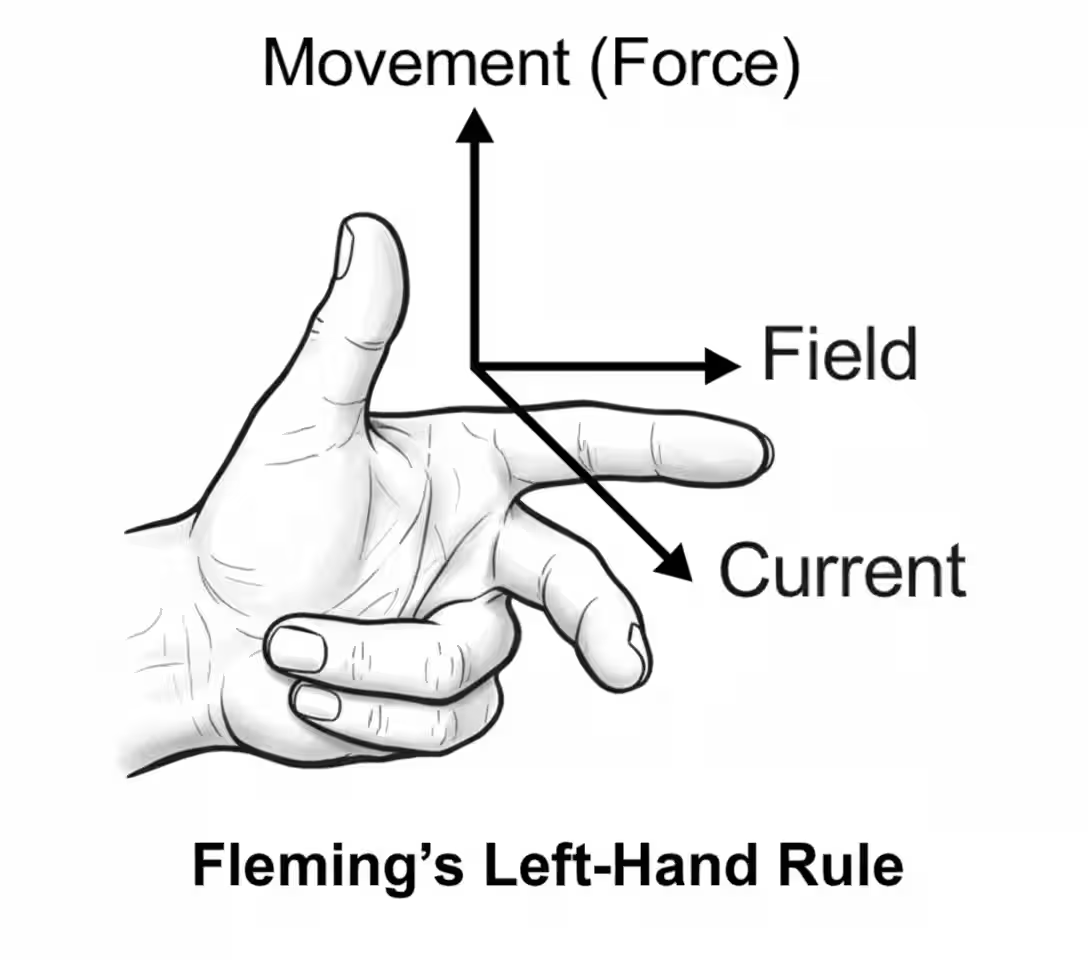
Figure: Fleming’s left-hand rule for magnetic force direction.
Negative Charge
Force direction is opposite to that of a positive charge moving the same way.
Quick Direction Logic
If a proton curves upward, an electron entering with the same velocity would curve downward.
Always check the sign of charge.
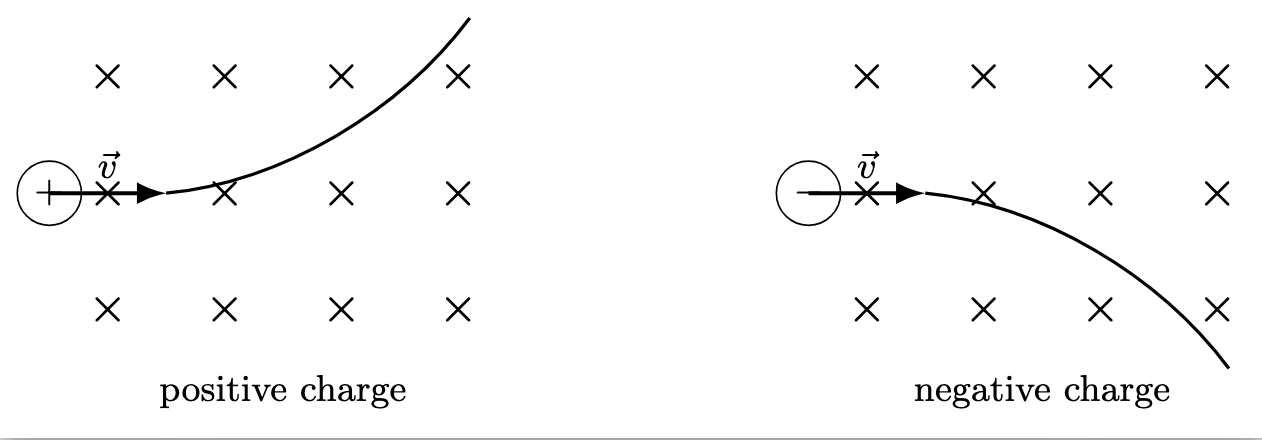
Figure: Opposite magnetic deflection of positive and negative charges.
Circular Motion in a Uniform Magnetic Field
If velocity is perpendicular to the field:
- force always perpendicular to velocity
- force acts as centripetal force
- speed is constant
- path is circular
Derivation of Radius
Magnetic force provides centripetal force:
Hence:
using magnitudes.
Meaning of Radius Formula
Larger radius if:
- larger mass
- larger speed
Smaller radius if:
- larger field strength
- larger charge magnitude
Period of Revolution
Using:
Substitute :
Important Consequence
The period does not depend on speed.
So:
- fast particles move in larger circles
- slow particles move in smaller circles
- both can have the same period if , , and are unchanged
Why Speed Stays Constant
Magnetic force is perpendicular to velocity.
Therefore:
- no component of force acts along the motion
- no work is done
- kinetic energy is unchanged
So speed stays constant while direction changes.
Energy Interpretation
Since work done is zero:
Hence:
This is why magnetic fields bend beams without speeding them up.
Helical Motion
If velocity has two components:
- : perpendicular to the field
- : parallel to the field
Then:
- gives circular motion
- remains unchanged
Result: helical path.
Helix Features
- stronger field gives a tighter spiral
- faster parallel speed gives a larger pitch
- no force acts on the parallel component
Straight-Line Motion
If the particle enters exactly parallel to the magnetic field:
Then:
The particle continues straight.
Velocity Selector
Uses perpendicular electric and magnetic fields.
For an undeflected particle:
- electric force balances magnetic force
So:
Only particles with this speed pass straight through.
Related topic: Electric Fields
Why Velocity Selector Works
If Particle Is Too Slow
Magnetic force is too small.
Electric force dominates.
The particle deflects one way.
If Particle Is Too Fast
Magnetic force is too large.
The particle deflects the opposite way.
Only the correct speed remains undeflected.
Exam-Style Particle Path Reasoning
Step 1
Identify field direction:
- into page
- out of page
Step 2
Identify sign of charge.
Step 3
Use the left-hand rule for a positive charge.
Step 4
Reverse for a negative charge.
Step 5
Recognise motion type:
- perpendicular entry gives a circle
- angled entry gives a helix
- parallel entry gives a straight line
Short Worked Examples
Example 1: Radius Change
If speed doubles:
Radius doubles.
Example 2: Stronger Field
If doubles:
Radius halves.
Example 3: Proton vs Electron
At the same speed and in the same field:
- they curve in opposite directions
- the electron usually has a much smaller radius due to its smaller mass
Common Mistakes
- Forgetting charge sign
- Thinking magnetic force changes speed
- Using the wrong radius proportionality
- Using the wrong angle
- Mixing electric and magnetic force directions