Rectification
Overview
Rectification is the process of converting alternating current into direct current.
Many electronic devices require a supply that flows in one direction only, while mains electricity is alternating. Rectification uses diodes to allow current to pass in only one direction.
This topic supports Alternating Current and connects strongly with Semiconductors and Diodes.
Definition
Alternating current reverses direction periodically. A diode behaves approximately as:
- forward-biased: conducts current
- reverse-biased: blocks current in the ideal model
By placing diodes appropriately in a circuit, unwanted halves of the AC waveform can be blocked or redirected.
Why It Matters
Rectification is the basic reason AC supply can be used to run circuits that require unidirectional current. It is also the bridge between AC supply systems and low-voltage electronic devices.
Key Representations
Diode One-Way Conduction
| Bias Condition | Current |
|---|---|
| Forward bias | flows |
| Reverse bias | negligible or zero |
In H2 Physics questions, the diode is usually treated as ideal unless stated otherwise.
Half-Wave Rectification
Circuit idea:
A single diode is connected in series with the load resistor.
Positive half-cycle:
- diode forward biased
- current flows
- output appears across the resistor
Negative half-cycle:
- diode reverse biased
- no current flows
- output is zero
Output form:
Only one half of the original waveform remains.
Features:
- simplest rectifier
- lower average output
- large gaps between pulses
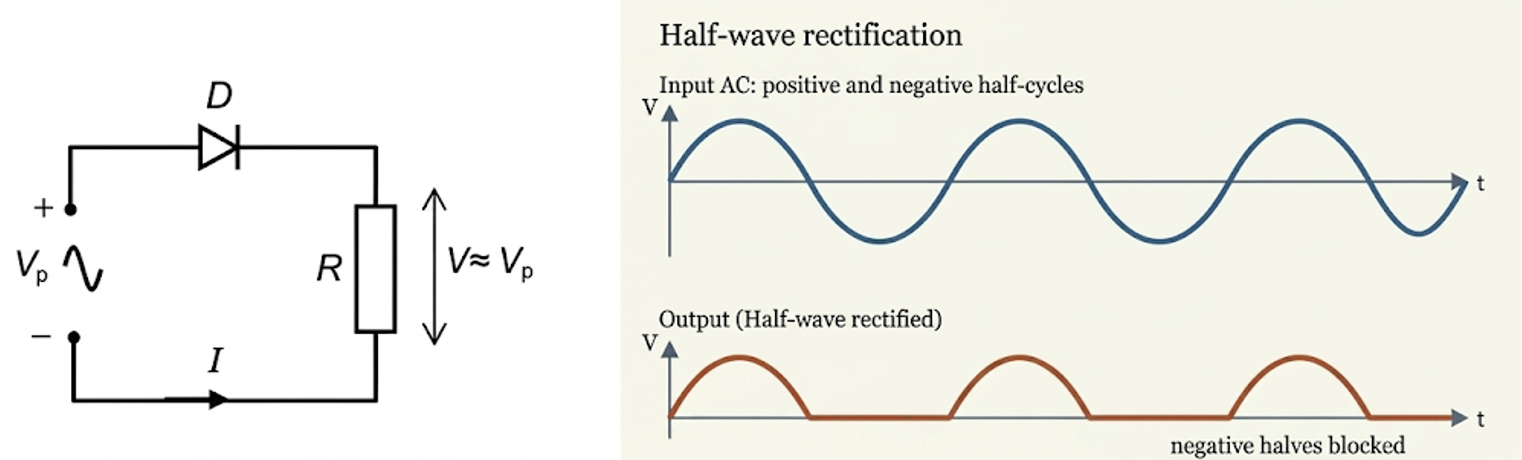
Figure: Half-wave rectification passes only one half-cycle, giving widely spaced pulses.
Full-Wave Rectification
Circuit idea:
Use four diodes in a bridge arrangement.
During each half-cycle, a different pair of diodes conducts so that current through the load resistor always flows in the same direction.
Result:
Both halves of the input waveform contribute to output.
Features:
- higher average output
- smaller gaps between pulses
- more efficient use of the input signal
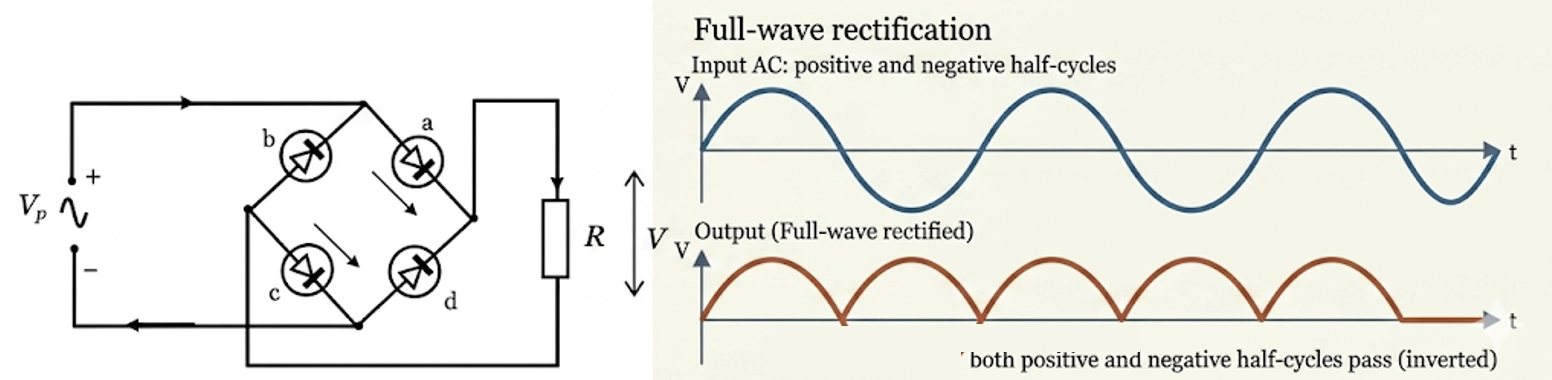
Figure: Full-wave rectification uses both half-cycles so the output stays unidirectional with more frequent pulses.
Why Current Direction Through the Load Stays the Same
Even when source polarity reverses:
- the conducting diode pair changes
- the path through the external resistor is redirected
- current through the resistor keeps the same direction
Waveform Comparison
| Property | Half-Wave | Full-Wave |
|---|---|---|
| Number of diodes | 1 | 4 |
| Uses both half-cycles? | no | yes |
| Ripple size | larger | smaller |
| Average output | lower | higher |
| Efficiency | lower | higher |
Pulsating DC
Rectified output is unidirectional, but it still varies with time.
So it is not constant DC from a battery. Output has:
- one direction only
- changing magnitude
- repeated peaks
This is called pulsating DC.
Smoothing Note
Enrichment:
A capacitor may be connected across the load to reduce fluctuations.
- it charges near peak voltage
- it discharges when output falls
So the output becomes more steady.
Common Mistakes
Saying rectified output is perfect DC
Wrong. It is pulsating unless smoothed.
Thinking current through the load reverses in a full-wave bridge
Wrong. Current through the load remains in the same direction.
Assuming half-wave uses the whole input
Wrong. One half-cycle is blocked.
Forgetting the ideal-diode assumption
Most exam questions neglect diode voltage drop unless stated otherwise.
Mixing input waveform with output waveform
Always sketch or describe the output across the load resistor.
Worked Logic Example
A sinusoidal input is connected to a half-wave rectifier.
Question: why is the mean output voltage greater than zero?
Reason:
- negative half-cycles are removed
- the remaining pulses are positive only
- the average value is therefore positive
Links
- Alternating Current
- Semiconductors and Diodes
- RMS and AC Power
- Alternating Current Common Exam Traps
Summary
Rectification converts AC to DC using diodes.
Half-wave rectification:
- one diode
- one half-cycle removed
- pulsating DC
Full-wave rectification:
- four-diode bridge
- both half-cycles used
- higher average output
- smoother pulsating DC
The key idea is that diodes control current direction, allowing AC supply to power DC devices.