Kinematic Quantities and Sign Conventions
Overview
Many kinematics mistakes arise not from difficult mathematics, but from weak definitions and inconsistent signs.
This page strengthens the core ideas behind:
- distance vs displacement
- speed vs velocity
- acceleration
- average vs instantaneous quantities
- one-dimensional sign conventions
- speeding up vs slowing down logic
Main hub: Kinematics
Why It Matters
Careful definitions and consistent signs prevent many of the most common early kinematics errors.
Definition
This page clarifies the meanings of the main kinematic quantities and the sign conventions used in one-dimensional motion.
Core Definitions
Key Representations
| Quantity | Symbol | Type | Meaning |
|---|---|---|---|
| Distance | Scalar | Total path length travelled | |
| Displacement | Vector / signed scalar in 1D | Change in position | |
| Speed | — | Scalar | Rate of change of distance |
| Velocity | Vector / signed scalar in 1D | Rate of change of displacement | |
| Acceleration | Vector / signed scalar in 1D | Rate of change of velocity |
Distance vs Displacement
Distance
Distance is the total length of the actual path travelled.
- scalar
- always non-negative
- ignores direction
Displacement
Displacement is the change in position from initial to final point.
- includes direction
- may be positive, negative, or zero
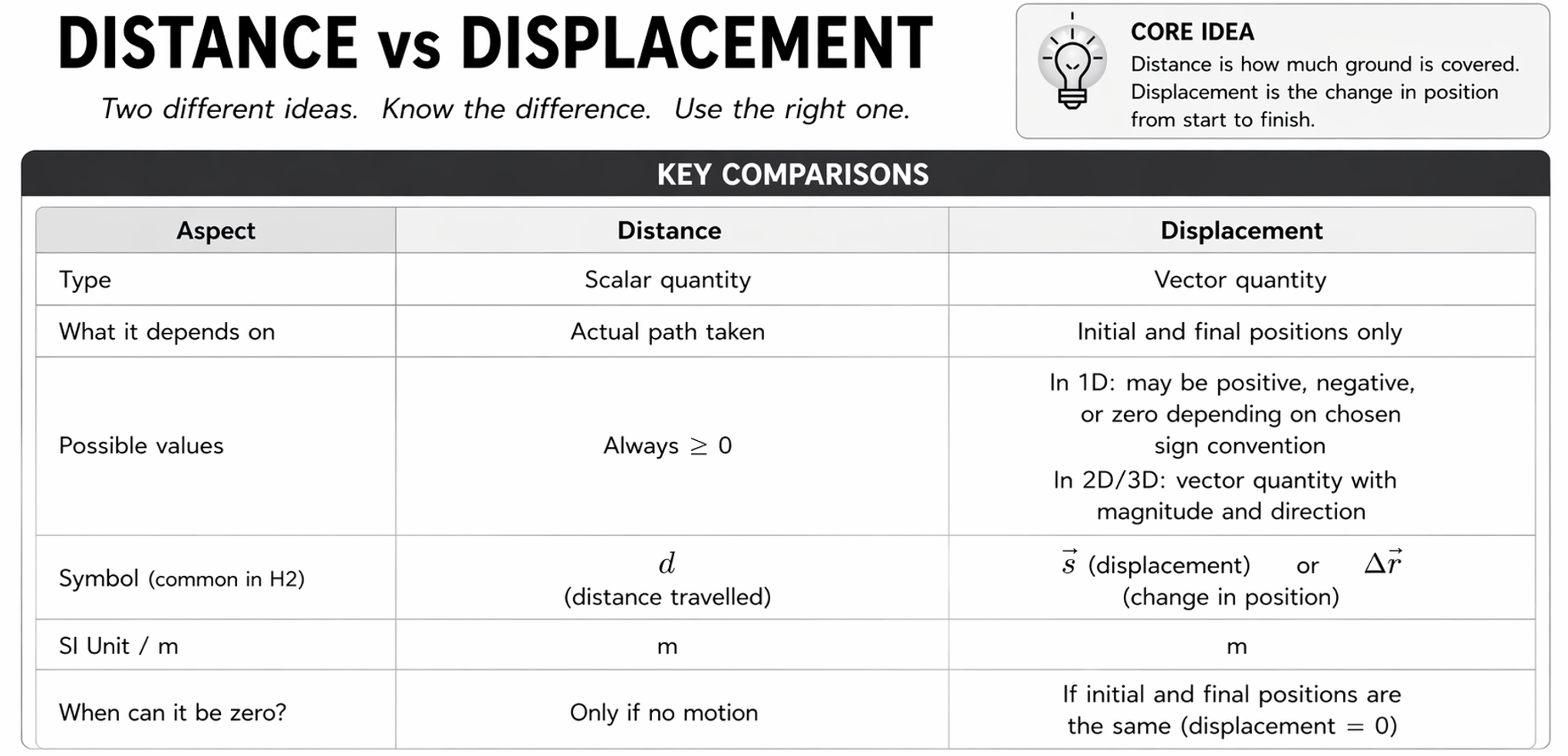
Figure: Distance is the actual path length travelled, while displacement is the straight-line change from initial to final position.
Example 1
A student walks 4 m east, then 1 m west.
Take east as positive.
- distance =
- displacement =
Example 2
A runner completes one full lap and returns to the start.
- distance = circumference of track
- displacement =
Speed vs Velocity
Average Speed
Average Velocity
Instantaneous Velocity
Velocity tells both magnitude and direction of motion.
Example
Car travels 100 m east in 5 s.
- average speed =
- average velocity = east
If it returns 100 m west in another 5 s:
- total distance = 200 m
- displacement = 0 m
- average speed = 20 m s
- average velocity = 0
Acceleration
Acceleration is the rate of change of velocity:
This means acceleration occurs when velocity changes in:
- magnitude (speeding up / slowing down)
- direction
- both
Hence an object moving in a curve can accelerate even at constant speed.
See Circular Motion
Average vs Instantaneous Quantities
Average Velocity
Average Acceleration
Instantaneous Forms
In graphs, instantaneous values are found from the tangent gradient.
See Kinematics Graphs and Calculus
Sign Conventions in 1D Motion
Choose a positive direction first.
Examples:
- right positive
- upward positive
- downhill positive
Then all vector quantities use that choice consistently.
Vertical Motion Example
If upward is positive:
If downward is positive:
The physical acceleration is still downward. Only the algebraic sign changes.
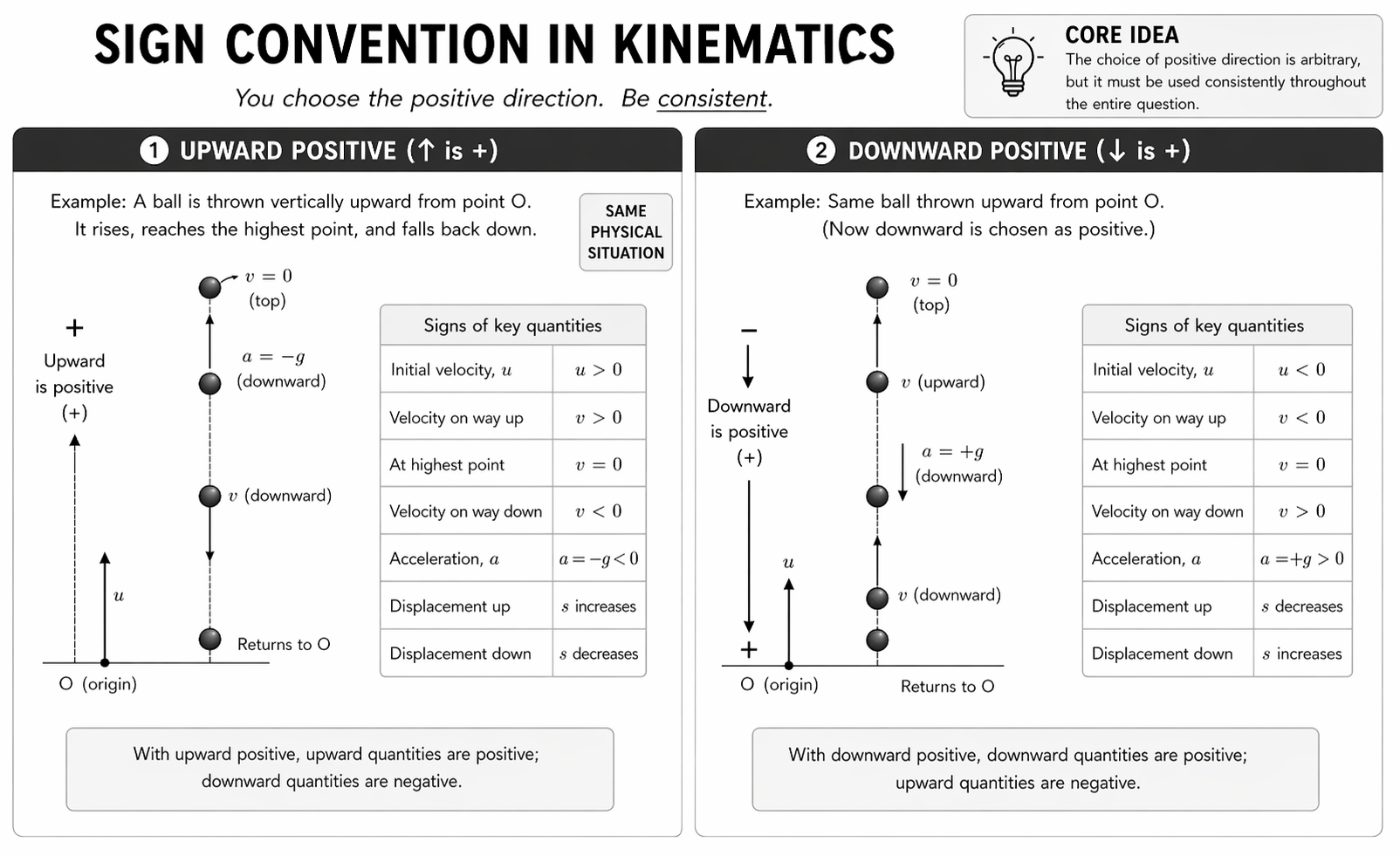
Figure: The same vertical-motion situation can be described with either upward or downward taken as positive, provided the sign convention is used consistently throughout.
The safest approach in exam work is to state your positive direction early, then keep the signs of (s), (v), and (a) consistent with that choice all the way through.
Velocity Sign Meaning
- → moving in positive direction
- → moving in negative direction
- → instantaneously at rest
Speeding Up vs Slowing Down
A common exam concept.
| Velocity | Acceleration | Motion |
|---|---|---|
| + | + | speeding up |
| + | - | slowing down |
| - | - | speeding up |
| - | + | slowing down |
Key Rule
- same sign → speed increases
- opposite signs → speed decreases
Example: Car Braking
Take right as positive.
A car moving right:
Braking force causes:
Velocity and acceleration opposite signs, so car slows down.
Example: Falling Ball
Take upward as positive.
Ball moving downward:
Gravity:
Same sign, so speed increases as it falls.
Turning Points
At highest point of a vertical throw:
but
So zero velocity does not mean zero acceleration.
Common Exam Pitfalls
- confusing distance with displacement
- writing speed as negative
- assuming negative acceleration always means slowing down
- changing sign convention midway
- forgetting velocity includes direction
- assuming implies
Quick Summary
- Distance and speed are scalars.
- Displacement, velocity and acceleration are vectors.
- In 1D, direction is represented by sign.
- Same sign of and means speeding up.
- Opposite sign means slowing down.
- Always define positive direction first.